
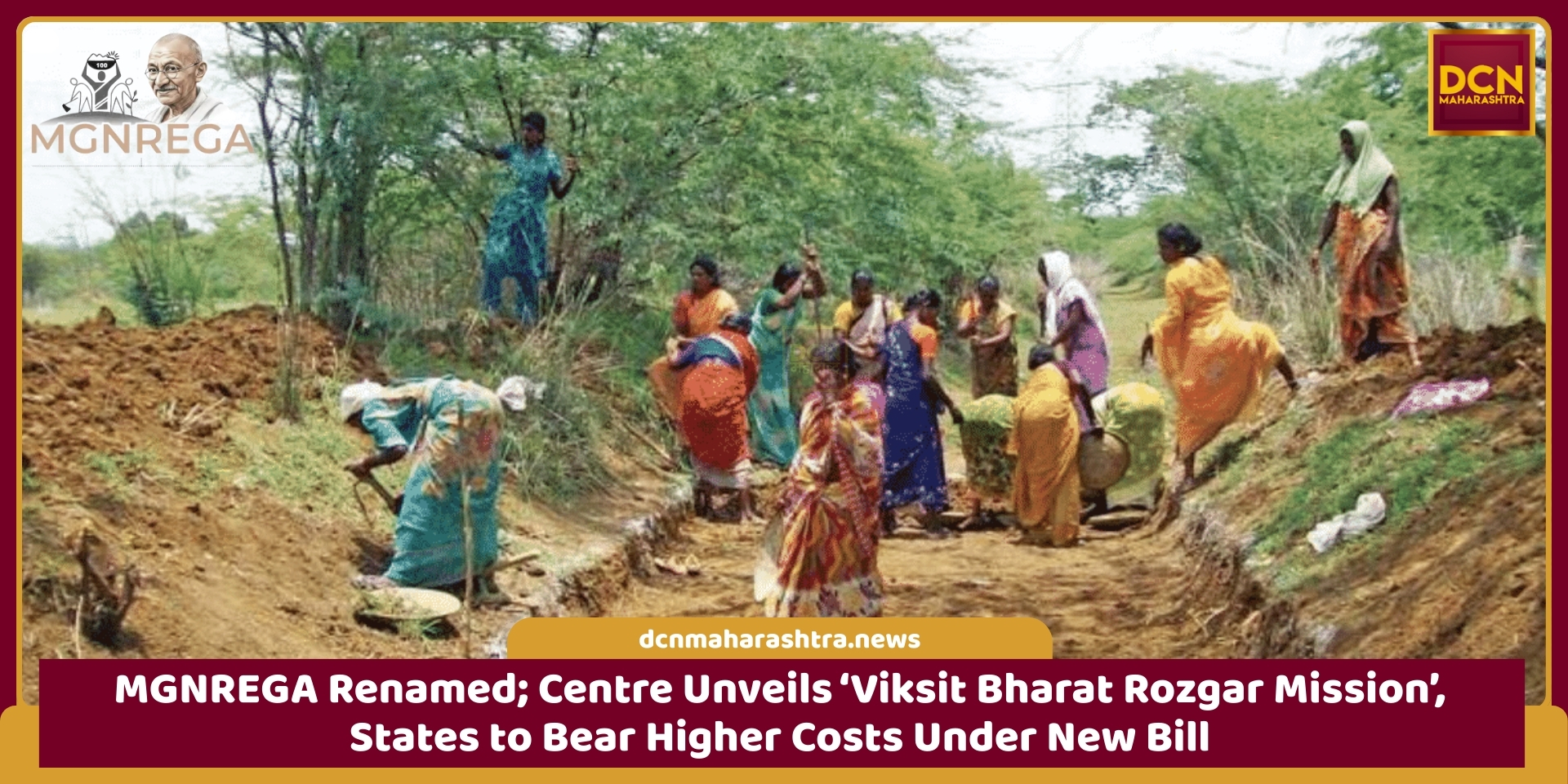
New Delhi: In a major policy overhaul, the Union Government has renamed the Mahatma Gandhi National Rural Employment Guarantee Act (MGNREGA) as Viksit Bharat — Guarantee for Rozgar and Ajeevika Mission (Gramin). The change marks a significant shift in the country’s rural employment framework, with the Centre positioning the revamped scheme as a more “transparent, modern and livelihood-focused” mission.
States’ Financial Burden to Rise Under VB—G RAM G BILL, 2025
A key component of the changes is the introduction of the VB—G RAM G BILL, 2025, which will increase the financial responsibility of state governments.
With more workdays guaranteed and expanded administrative requirements, states will have to allocate higher budgets—particularly for material costs, wage top-ups, and monitoring systems.
Senior officials say this is part of the Centre’s push to make states “equal partners” in rural employment delivery.
Employment Guarantee Raised to 125 Days
One of the biggest reforms is the enhancement of guaranteed wage employment from 100 days to 125 days per rural household every year. The move is aimed at providing greater income stability for families dependent on seasonal and agricultural labour.
60:40 Funding Pattern Retained, But States to Spend More
While the traditional 60:40 cost-sharing formula remains intact—Centre funding 60%, States 40%—the increase in workdays and administrative layers means states are likely to witness a higher overall spending outflow.
Weekly Wage Payments to Cut Delays
To address long-standing complaints of delayed payments, the new mission mandates that wages must be disbursed weekly, instead of the earlier fortnightly or monthly cycles.
60-Day Work Pause During Peak Farm Season
To ensure enough hands are available for agriculture during critical sowing and harvesting periods, the scheme introduces a 60-day no-work window each year.
Unemployment Allowance for Delayed Work Allocation
The original spirit of MGNREGA stays intact—if work is not provided within 15 days of application, states must pay a daily unemployment allowance to the applicant.